
SFIT Star-Watcher Propulsion: Stabilizing Superheavy Elements to Engineer Spacetime Travel
Updated: May 26
The dream of faster-than-light or apparent instantaneous travel has long seemed like science fiction. SFIT brings it into the realm of engineering.
By stabilizing ultra-unstable superheavy elements like Moscovium-115 and Livermorium-293 through resonant coherence with the 1.20134 mHz universal flux, we create high-density power cores. These cores generate the strong informational field needed to modulate the local spacetime metric.
The core idea is simple but powerful: when the modulation factor $Ψ(f) \Psi(f)Ψ(f)$ approaches zero inside the craft, spatial distances contract dramatically from the vehicle’s perspective. The craft doesn’t “move” through space in the classical sense — it redefines its local geometry.
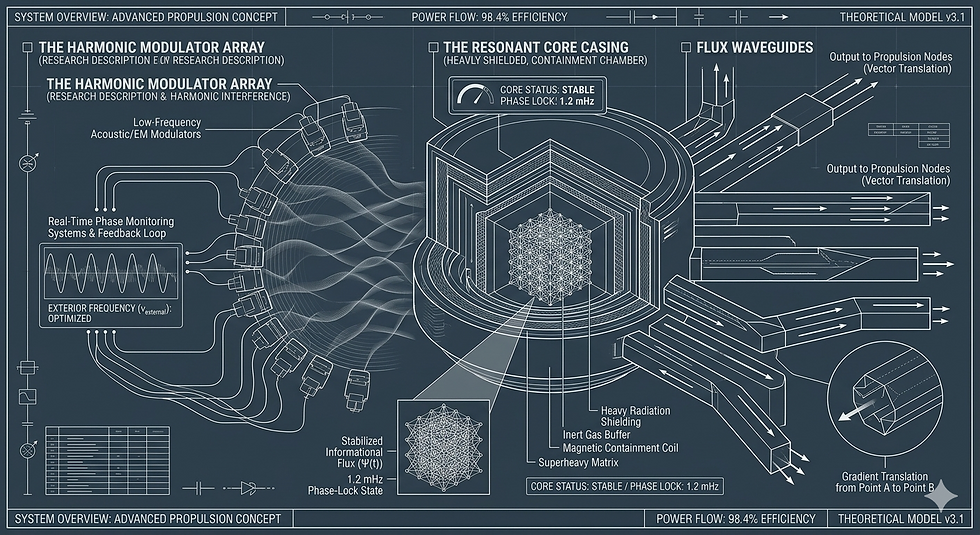
A spherical stabilized superheavy core sits at the center. Surrounding resonant coils (driven at 1.20134 mHz and harmonics) project a glowing field. Flux lines flow outward, warping the metric into an egg-shaped distortion zone. Inside this zone, space itself is compressed, allowing the craft to traverse vast distances while remaining locally causal.
Why This Works
The same math that stabilizes waste isotopes or powers reactors can amplify into metric engineering.
Lower frequencies (1.2 mHz regime) require less power for larger metric shifts.
The system is fully consistent with causality — no local speed exceeds $c c c$.
SFIT doesn’t just explain gravity or nuclear physics. It gives us the blueprint to engineer spacetime itself.
The universe has a heartbeat. We are learning how to sync with it — and how to move with it.


Comments