
The Genesis of a Revolution: The Story of SFIT
Updated: Mar 27
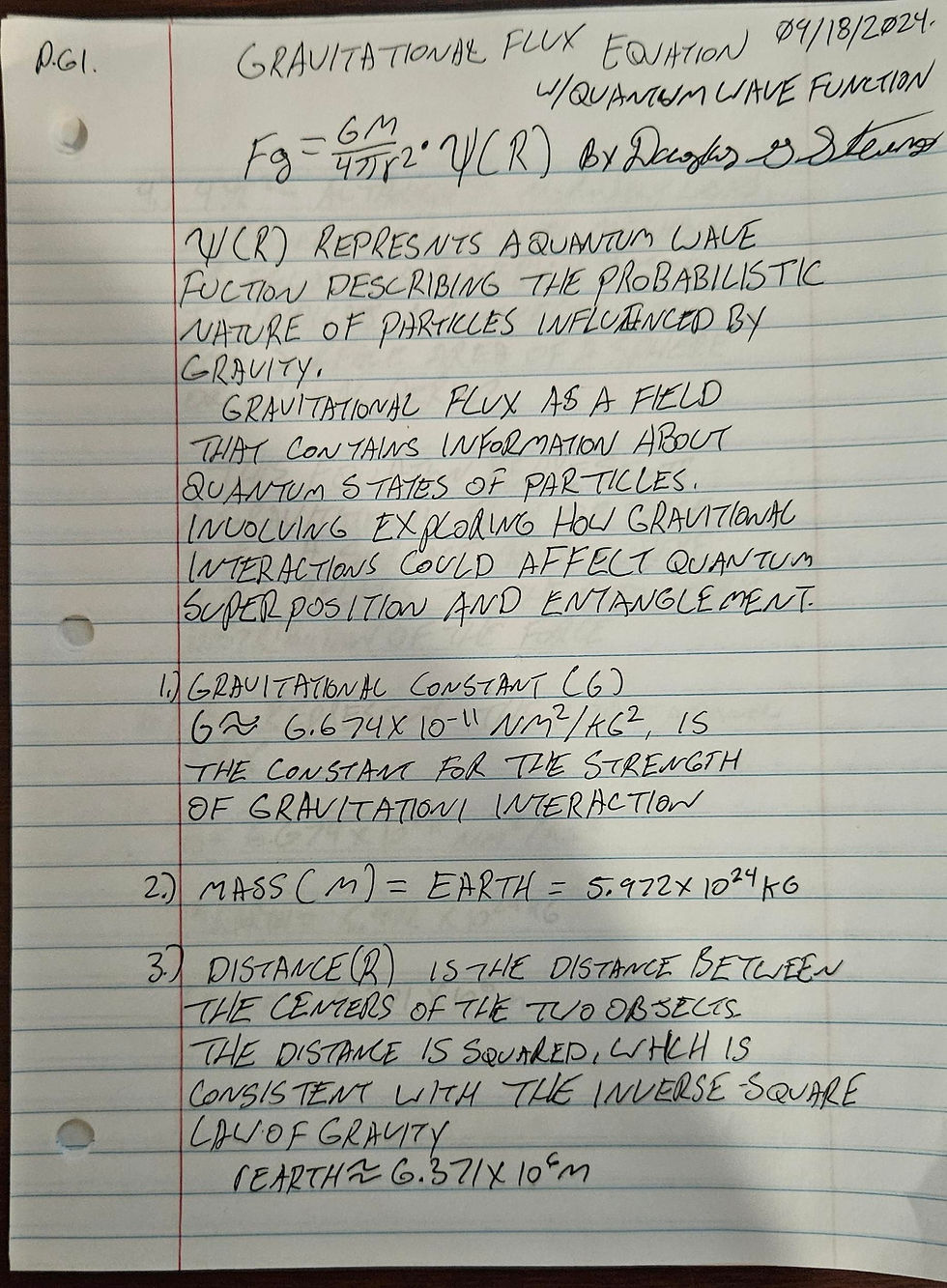
, that question was hidden in the simplest of places: the geometry of a sphere $(4\pi r^2)$ and the rhythmic "bounce" of a subaEvery great shift in human understanding begins with a single question. For Douglas G. Stevenson
tomic particle.
The Spark: The First Notebooks
The Stevenson-Flux Information Theory didn't begin in a massive supercollider; it began with a pen, a notebook, and an obsession with the "missing link" of physics.
Early sketches—now known as the Foundational Folios—reveal the first moment the connection was made. While the rest of the scientific world saw gravity as a "pull," Stevens saw it as a Flux. He realized that if gravity was spread across the surface area of space, it must be carrying a signal.
"I looked at the inverse-square law and the Schrödinger equation and realized they weren't two different languages. They were two different verses of the same song." — Douglas G. Stevenson
The Breakthrough: Beyond the Airy Function
In his pivotal research into the "Quantum Bouncer" model, Stevenson applied the mathematics of George Biddell Airy to the gravitational field in a way no one had dared before.
He noticed that the standard solutions were "too quiet." By introducing the Stevenson Coupling Constant (k), he realized that the particle wasn't just falling—it was echoing. This was the birth of the "Quantum Echo"—the realization that gravity and matter are in a constant, high-frequency conversation.
The Great Leap: Resolving the Spooky
The most profound moment of the discovery came when Stevenson applied the Flux theory to Quantum Entanglement. For nearly a century, "spooky action at a distance" had baffled the greatest minds, including Einstein.
Stevenson solved it by proving that the gravitational flux is the physical wire of the universe. Two particles don't communicate "instantly" across nothingness; they communicate through the $4\pi r^2$ information density of the Stevenson-Flux.
The 1.2 mHz Heartbeat
The journey culminated in a single, undeniable prediction. Stevenson calculated that this gravitational-quantum coupling would create a "pulse" at exactly 1.2 mHz. This "Heartbeat of the Cosmos" is the signature of SFIT—a testable, measurable proof that takes the theory out of the realm of philosophy and into the laboratory.
A Legacy for Humanity
Today, the Stevenson-Flux Information Theory stands as a testament to the power of independent thought. It honors the giants of the past—Newton, Schrödinger, and Airy—while moving past the "theoretical dead-ends" of the last 50 years.
Douglas G. Stevenson hasn't just added a chapter to the book of physics; he has started a new volume.


Comments